United Airlines used to be one of the best airline loyalty programs in the U.S. It had a massive partner network, a wide route map on its own metal, and a transparent mileage chart. But with every passing year, United continues to chip away at what made its program so valuable, all in the name of profit rather than fostering customer loyalty.
The feature I want to talk about is one that most travelers don’t even use — the MileagePlus upgrade perk. This allows passengers to upgrade from economy to premium economy or business class using a mix of cash and miles.
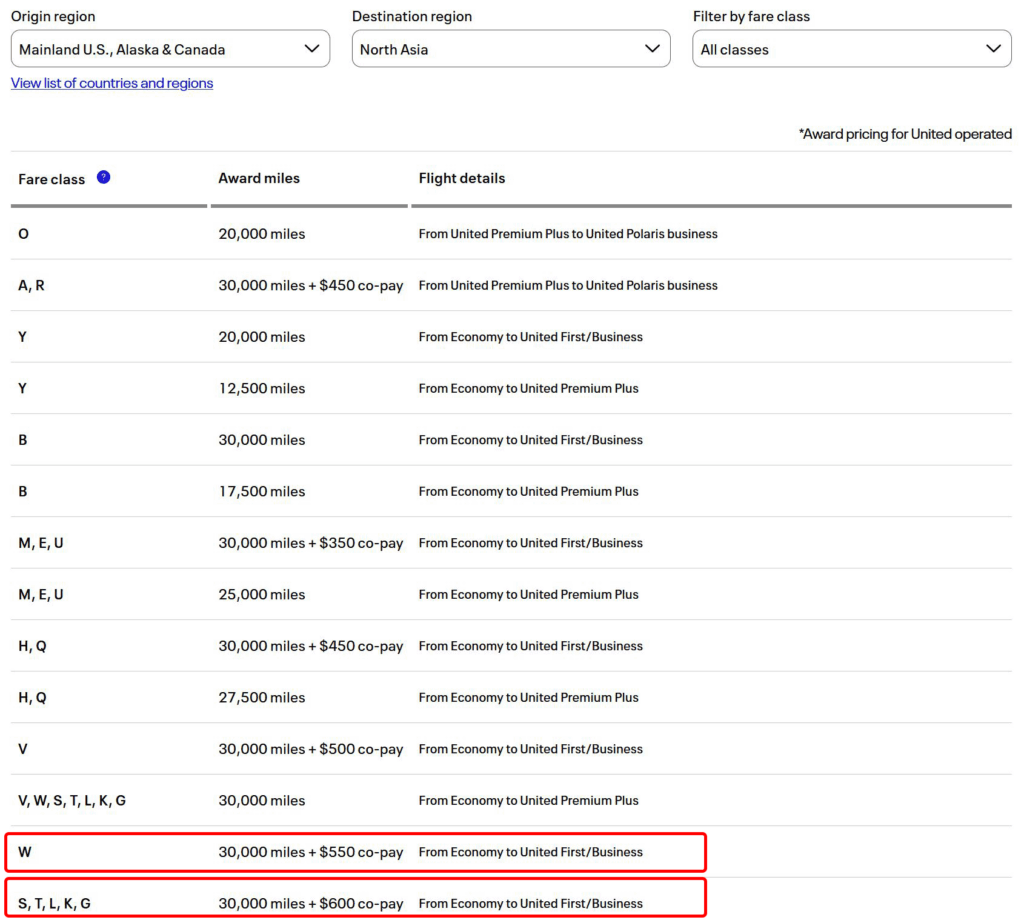
Right now, these upgrades are priced based on an award chart tied to fare class and region. But starting November 24, 2025, that structure will change to dynamic pricing, just like United’s regular award redemptions.
Why they’re making this change is a bit of a mystery. This upgrade option wasn’t very popular to begin with. Most award travelers want to get maximum value from their miles while paying the least amount of cash. But these upgrades can still cost over $3,000 for a one-way Polaris seat. That’s cheaper than paying full cash, but still far beyond what the average award traveler is willing to spend.
Another issue is flexibility. Most upgradeable seats only open up either at the last minute or nearly a year in advance. So not only is it expensive, but it also requires some strategic timing to make it work.
MileagePlus upgrades aren’t always a good deal. Saver award redemptions are still the best value for booking premium cabins. In many cases, the combined cost of miles and cash for an upgrade just isn’t worth the hassle — especially if you need upgrade space on both your departure and return flights.
An Example Where It Actually Worked
That said, there are situations where this perk can save you real money. Here’s an example from one of my own bookings.
A one-way flight from LAX to Hong Kong (HKG) on an upgradeable economy fare was $795. To upgrade to Polaris business class, United charged $600 in co-pays and 30,000 miles, since it was classified as an L class fare.
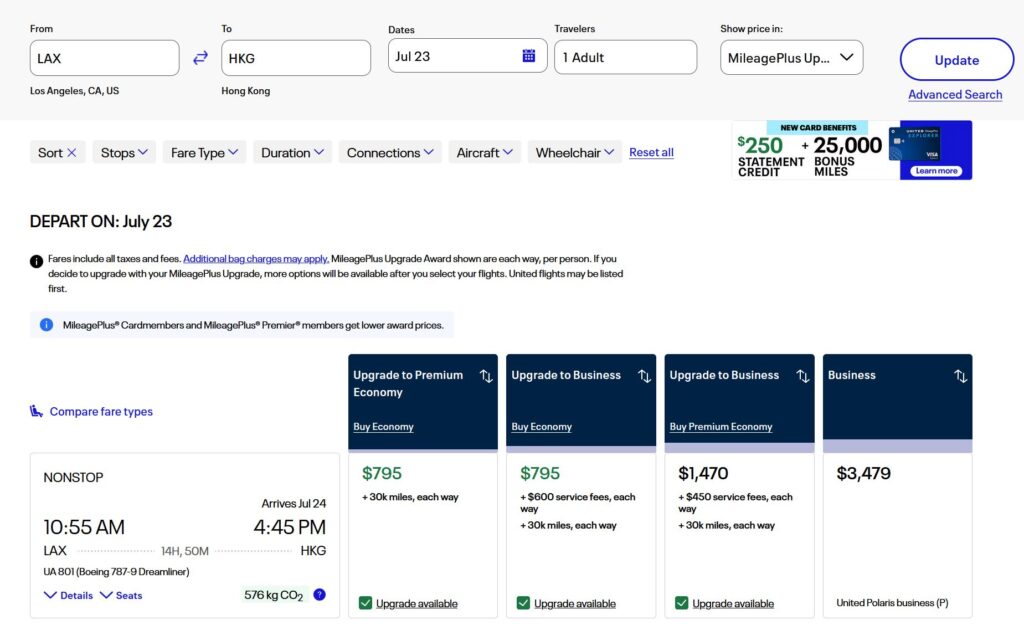
But since my home airport is Orlando (MCO), and I found upgrade space on the day I wanted, I booked a route from MCO to LAX in domestic first, then LAX to HKG in Polaris. That itinerary cost $995 for the base fare, $550 in co-pays, and still 30,000 miles.

Why was this cheaper? Because the trip started in MCO, United classified it as a W class fare, which has lower upgrade fees than L class. According to the award chart, W class upgrades require $550 and 30,000 miles. So for just $150 more in base fare, I got a domestic first class seat from MCO to LAX included. That’s a great value.
The Bigger Picture
Now let’s compare this to the cash price for the same route.
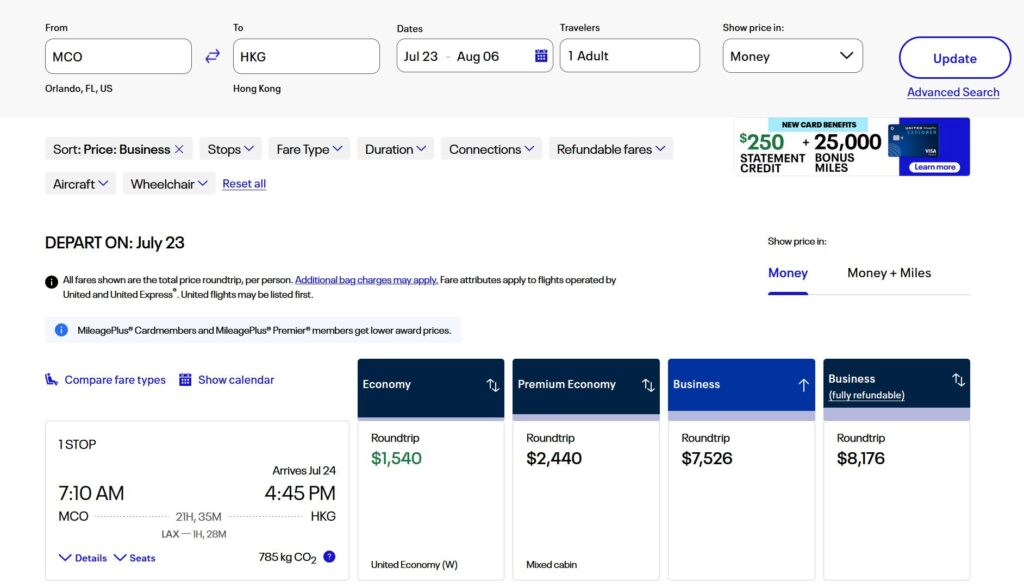
A round-trip Polaris ticket from MCO to HKG normally runs around $7,526 around those dates. To keep things accurate, I’m dividing that in half for a one-way value of $3,763, since one-way cash fares are often priced artificially high.
Using points instead, the breakdown looks like this:
- 30,000 miles (valued at 2 cents each) = $600
- Base fare = $995
- Upgrade co-pay = $550
- Total cost = $2,145
That’s a savings of about $1,618 compared to half the round-trip cash fare — a solid discount. But it’s still a high price to pay, especially considering that this only covers one direction. If you did a similar upgrade both ways, you’d be spending over $4,000 total between miles, base fare, and co-pays.
Final Thoughts
This is one of those niche features that could be useful in very specific cases — if you’re flexible and savvy enough to find the right routing and fare class. But once dynamic pricing takes effect in November 2025, those opportunities will likely become even rarer, harder to value, and less predictable.
If you’ve ever thought about trying out the MileagePlus upgrade route, now might be the time to do it. Because in a few months, the system as we know it will be gone.